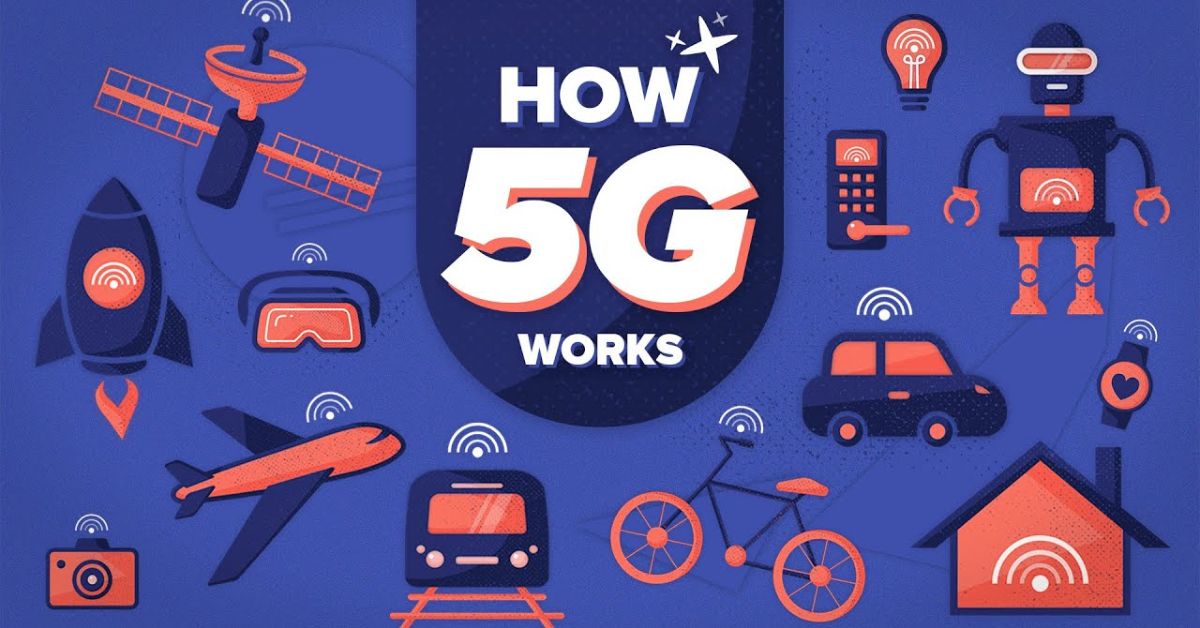
Slow downloads, video buffering, and weak connections can quickly become frustrating. As more devices connect to the internet, people need faster and more reliable ways to stay connected. This is where 5G Technology is creating new possibilities for everyday users and businesses.
From smartphones to smart factories, modern networks are handling more data than ever. In this article, you’ll learn how 5G networks work, what makes them different from 4G, and where they are being used. We’ll also explore their role in IoT, smart cities, and the future of digital connectivity.
How do 5G networks work?
5G is the fifth generation of cellular networks. It uses radio frequencies to send data between your device and nearby network equipment. A 5G network combines advanced radio access technology, new spectrum bands, antennas, and software to deliver faster data rates and better network performance. Your phone connects to a nearby cell site, which then sends data through the operator’s core network and onward to the internet.
One important part of 5G is its use of different frequency bands. Low-band 5G offers wider coverage, while mid-band 5G provides a balance between speed and coverage. High-band 5G can deliver very high speeds but usually covers shorter distances. Small cells can also help improve capacity in crowded areas. Together, these technologies support high-capacity connectivity and more efficient wireless communication.
The Evolution from 1G to 5G: A Quick Overview
Mobile networks have changed significantly over the past few decades. 1G introduced basic analog voice calls, while 2G brought digital communication and services such as text messaging. 3G made mobile internet more practical, and 4G expanded mobile broadband with much faster data connections. Each generation improved the way people communicated and accessed online services.
5G continues this evolution by focusing on more than smartphone speed. It supports massive device connectivity, lower latency, higher network capacity, and new real-time applications. This makes next-generation networks useful for connected vehicles, industrial IoT, smart infrastructure, and other forms of digital transformation. The goal isn’t simply to make phones faster. It’s also to connect more devices and support new ways of using data.
5G’s key features and capabilities
The main strength of 5G comes from several technologies working together. These include faster speeds, wider bandwidths, lower latency, better capacity, and support for a huge number of connected devices. These features can improve mobile broadband while also supporting mission-critical applications.
The benefits can vary depending on the spectrum, network design, device, and local deployment. A 5G connection in one location may perform differently from another. Still, the technology provides a strong foundation for high-speed internet, enterprise connectivity, and advanced digital services.
Readout This Article: Grant Horvat Height
Faster speeds
One of the most noticeable advantages of 5G Technology is its potential for faster data rates. You can download large files, stream high-quality video, and use cloud-based services with less waiting when network conditions support high speeds. Faster connections can also improve mobile cloud gaming and other data-heavy services.
Wider bandwidths
Bandwidth refers to how much data a network can carry over a given period. 5G uses a wider range of spectrum to increase network capacity and support more traffic. This becomes especially useful in places where many people use their devices at the same time.
Efficient coverage
5G coverage depends heavily on the frequency band and network infrastructure. Low-band 5G can travel farther and work well for broad coverage, while mid-band networks can offer a useful balance of speed and range. High-band networks can provide very high capacity but often need more small-cell deployment.
Lower latency
Latency is the time it takes for data to travel between devices and network systems. 5G aims to provide ultra-low latency, which can make real-time connectivity more responsive. This matters for applications such as remote control systems, industrial automation, online gaming, and other services where quick responses are important.
Massive connections
Modern cities and businesses may have thousands or millions of connected devices. 5G is designed to support massive device connectivity without treating every connection like a traditional smartphone connection. This capability is especially important for massive IoT, sensors, smart equipment, and industrial IoT deployments.
Precise positioning
5G can also support more precise positioning capabilities than earlier mobile technologies in suitable deployments. Accurate location information can help with logistics, transportation, asset tracking, and smart infrastructure. For example, connected systems can use positioning data to understand where vehicles or equipment are located.
Readout this Article: Saquon Barkley Height
5G vs 4G at a glance
4G transformed mobile internet by making fast mobile broadband widely practical. 5G builds on that foundation while adding higher capacity, lower latency, and support for many more connected devices. However, the exact difference between 4G and 5G depends on the network, spectrum, device, and environment.
| Feature | 4G | 5G |
| Generation | Fourth generation | Fifth generation |
| Speed | Fast mobile data | Higher potential data rates |
| Latency | Higher | Lower potential latency |
| Network capacity | High | Higher capacity |
| Connected devices | Supports many devices | Designed for massive connectivity |
| Main focus | Mobile broadband | Broadband, IoT, automation, and advanced applications |
| Spectrum | Primarily lower and mid bands | Low, mid, and high frequency bands |
So, 5G vs 4G isn’t only about speed. 5G is designed to handle different types of connections and workloads. For businesses, this can mean better enterprise connectivity and new applications. For consumers, it can mean faster downloads, smoother streaming, and more responsive online services when suitable coverage is available.
The Impact of 5G on Different Industries
The influence of 5G extends beyond smartphones. Businesses can use high-capacity connectivity to connect machines, workers, vehicles, and cloud services. Lower latency can also help organizations build real-time applications that weren’t practical with older networks.
Different industries can use the technology in different ways. For example, healthcare can benefit from connected medical systems, while manufacturers can connect robots and sensors. Logistics companies can use connected vehicles and precise positioning to monitor operations. These applications can support faster data processing and more efficient workflows.
Some important 5G use cases and applications include:
- Healthcare: Connected medical devices and e-health services.
- Manufacturing: Industrial automation and industrial IoT.
- Transportation: Connected vehicles and smarter logistics.
- Gaming: Mobile cloud gaming with responsive connections.
- Retail: Connected systems and improved customer experiences.
- Business: Reliable enterprise connectivity and flexible network services.
5G can also support network slicing, which allows network resources to be configured for different requirements. For example, a business may need one type of service for ordinary data traffic and another for mission-critical applications. This flexibility can help organizations manage quality of service according to their needs.
The Role of 5G in IoT (Internet of Things)
The Internet of Things connects physical objects to digital networks. These objects can include sensors, machines, vehicles, appliances, and industrial equipment. As IoT deployments grow, networks need to support massive numbers of connected devices while handling different levels of data traffic and performance requirements.
5G can support IoT through massive device connectivity, improved capacity, and real-time connectivity. Edge computing can process some data closer to where it is generated instead of sending everything to a distant data center. This can reduce unnecessary data movement and help applications respond more quickly. Network slicing can also provide customized network resources for different IoT use cases.
For businesses, 5G technology can make industrial IoT more practical in environments where many machines need to communicate. A factory, for example, could connect sensors, robots, cameras, and monitoring systems. These connected systems can share information quickly and help teams monitor operations more effectively.
5G and the Future of Smart Cities
Smart cities rely on connected infrastructure to collect and process information. Traffic lights, public transport systems, parking systems, environmental sensors, and other devices can generate large amounts of data. A reliable mobile network can help these systems communicate and share information in real time.
5G can support smart infrastructure by providing high-capacity connectivity for large numbers of devices. Connected vehicles could communicate with city systems, while sensors could monitor traffic, energy use, or environmental conditions. These applications can support better data processing and help cities respond to changing conditions more efficiently.
For example, a smart traffic system could collect information from connected vehicles and roadside sensors. The system could then analyze traffic conditions and adjust signals based on current demand. While the exact capabilities depend on deployment, 5G provides a network foundation for many such connected-city applications.
Readout This Article: Megan Thee Stallion Height
Challenges and Opportunities in the Adoption of 5G
Deploying 5G isn’t as simple as switching on a new network. Operators need suitable spectrum, new infrastructure, compatible devices, and reliable network coverage. High-band frequencies may require many small cells because their signals don’t travel as far. Costs, planning, security, and local regulations can also affect deployment.
Key challenges include:
- Infrastructure and deployment costs
- Spectrum availability
- Network coverage limitations
- Small-cell deployment requirements
- Device compatibility
- Security and privacy concerns
- Managing complex network infrastructure
At the same time, 5G creates opportunities for businesses and public infrastructure. Companies can explore new applications built around enterprise connectivity, automation, edge computing, and connected devices. AI-based network automation may also help operators manage increasingly complex networks. As the technology evolves, these capabilities could support broader digital transformation across industries.
FAQs
1. What is 5G Technology?
5G Technology is the fifth generation of cellular networking. It is designed to provide faster data rates, lower latency, higher capacity, and support for many connected devices.
2. How do 5G networks work?
5G networks use radio frequencies, antennas, network infrastructure, and advanced software to transfer data between devices and the network.
3. How fast is 5G compared to 4G?
5G can provide significantly higher speeds than 4G under suitable conditions. Actual speeds depend on spectrum, network deployment, device capability, and coverage.
4. What are the main benefits of 5G Technology?
Major benefits include faster connectivity, lower latency, greater network capacity, and support for massive numbers of connected devices.
5. How does 5G support IoT and smart cities?
5G can connect large numbers of sensors and devices while supporting high-capacity and real-time communication. This makes it useful for IoT systems and smart infrastructure.
Conclusion
5G Technology is changing mobile network technology by bringing faster data rates, lower latency, and greater capacity. Its role goes beyond smartphones, with applications in IoT, industrial automation, healthcare, transportation, and smart cities.
As networks continue to evolve, businesses and communities can explore new ways to use connected devices and real-time data. With the right infrastructure and deployment, 5G can become an important part of the next generation of digital connectivity.
